Mud, Sweat, and Tears: The Lourdes Grotto at the Mother Church of the Acadians
This article was originally published in the Spring 2026 issue of Joie de Vivre Journal.
There is a particular kind of silence that belongs to places where centuries of prayers meet your own. At St. Martin de Tours Catholic Church in St. Martinville, that silence is obvious. It gathers in all corners of the Church like the layers of incense that have collected there since the church was built in 1836. There are many unique features in the church that lift the mind and heart to God, but one in particular tells the story of this city built from the collision of Catholic Faith and human struggle. The Lourdes Grotto, which covers the entire Marian side altar, is built to echo faithfully a faraway French cave, yet is crafted from the very mud of the Bayou Teche which welcomed the European missionaries, the Acadian exiles, and the African slaves who themselves became the bricks that built up this strong city that still thrives after 260 years. This grotto, built merely 25 years after Our Lady’s apparitions at Lourdes using nothing more than a single picture for reference, is more than a devotional niche. It is a unique and living testament to the City of God and the city of St. Martinville.
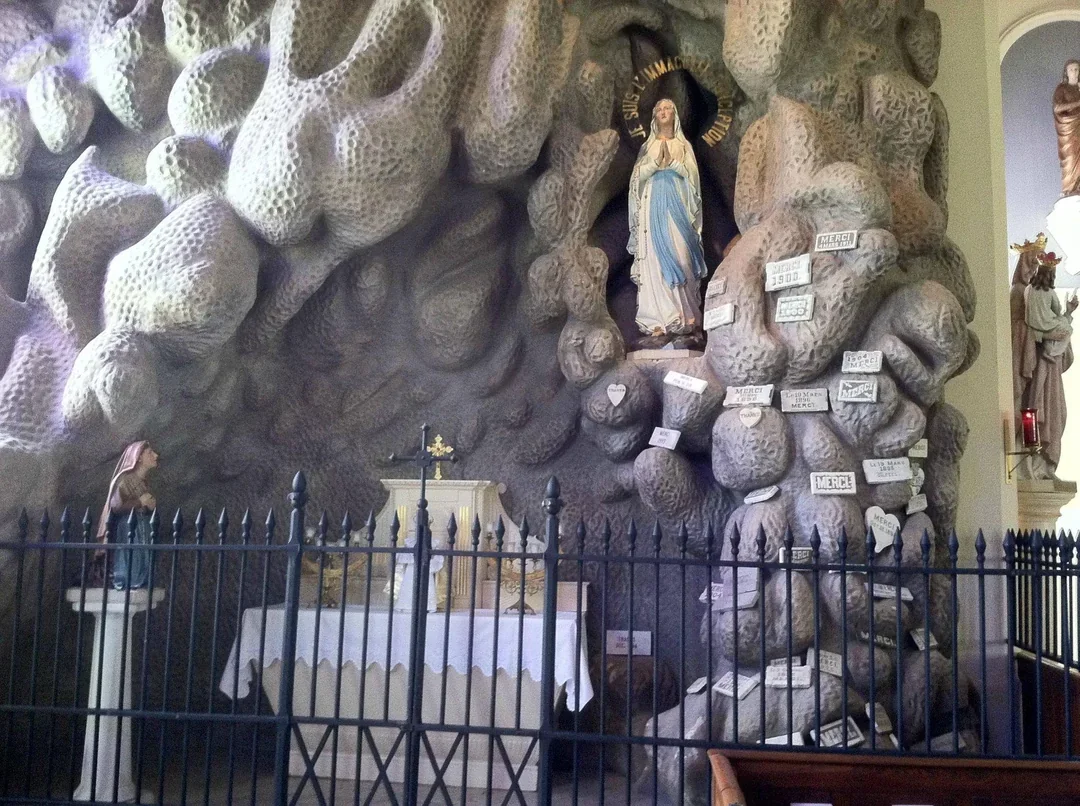
Lourdes Grotto in St. Martin de Tours Church, St. Martinville, LA.
The winding Bayou Teche historically served as a reliable highway. This narrow, calm river is part of the Atchafalaya water system that connects the Mississippi to the Gulf Coast, flowing 125 miles from Port Barre to Berwick where it flows into the Atchafalaya River. In the mid 1700s, the French organized the mission territory in Louisiana into posts that best served the pastoral needs of French colonists and their slaves, with the waterways chosen as the locations of the posts for easier missionary travel. The Poste des Attakapas (Attakapas Post) was established where St. Martinville stands today, its jurisdiction covering much of what became Acadiana. Benedictine missionary Fr. Pierre Didier, who had served at the Natchitoches post, was assigned to it. Upon arrival, he named the mission St. Joseph of the Attakapas. He soon recorded the first Sacraments in the region when witnessing the marriage of André Masse and baptizing many of his slaves, including Marie Senegal, traditionally remembered as the first person baptized in the Attakapas region on June 5, 1756.
One year before Marie’s baptism, the first of many groups of French Canadian settlers were brutally exiled from their home in Acadie, Nova Scotia by the British beginning in 1755. Some Acadians eventually made their way to French Louisiana, about 2000 miles away, by way of the Atlantic and the port of New Orleans. After some twenty years of displacement and travel, a group of these exiles arrived in May of 1765 at the now Spanish-owned Attakaps Post accompanied by the French Capuchin priest Fr. Jean-Francois Civrey. Fr. Civrey founded a new parish and became its first pastor. He called the parish l’Eglise de la Nouvelle Acadie aux Attakapas (the Church of New Acadie at Attakapas), and it was placed under the patronage of St. Martin de Tours, the beloved French saint who was frequently invoked by French missionaries. As this was the first church parish of the Acadians, St. Martin de Tours is rightly regarded as the Mother Church of the Acadians. The founding date of May 1765 makes St. Martin de Tours the third oldest functioning Catholic parish in the State of Louisiana, after the Minor Basilica of the Immaculate Conception in Natchitoches (1717) and the Cathedral-Basilica of St. Louis in New Orleans (1720). St. Martinville was incorporated in 1817, but the city marks its founding at the same time as the founding of the parish of St. Martin de Tours in 1765. Continued growth of the parish and the Cajun people led to the construction of a new church building in 1836 which still stands today. The church was designed by Pierre Benjamin Buisson, a well-known architect from New Orleans, in the Greek Revival style. Originally a simple rectangular Roman basilica plan, with the nave separated from the side aisles by rows of columns on square pedestals, it has been improved over the years including the Lourdes Grotto in the 1870s. However, the earliest pictures of the church are strikingly similar to the most recent ones, giving St. Martin de Tours its unique historic and timeless quality.
The apparitions of the Blessed Virgin Mary to St. Bernadette Soubirous in 1858 captivated Catholics worldwide, especially French speaking Catholics such as those in St. Martinville. In the mid 1870s, a postcard of the grotto and shrine that had been erected at Lourdes was delivered to a Creole man of color named Pierre François Hyppolite Martinet (1847–1905). Hyppolite was the son of a Belgian father of the same name and Marie-Louise Benoit, a free woman of color. The historical struggles of Africans and Cajuns generated a natural sympathy between people of vastly different origins. Under French and Spanish colonial rule, free people of color in St. Martinville flourished more than other parts of the Southern U.S. Sharing the French language and the Catholic Faith helped create an environment that allowed notable examples of cooperation between races, mutual support, and intermarriage. Many French-Speaking Catholics of African descent came to Louisiana by way of Haiti, especially during and after the Haitian Revolution (1791-1804), bringing with them a tradition of rich Faith that endured much suffering. The mother Church of the Acadians was also a mother to many other children, and the city was built up in the 19th century by architects, laborers, and farmers with a variety of skin tones and heritages united by their Catholic Faith. Hyppolite Martinet was one of those architects and builders, an example of the many people of color who made lasting contributions to the city and the Church in St. Martinville.
Inspired by the postcard he received, inflamed with devotion to God and the Virgin Mary, and under the support of Fr. Ange Marie Jan the pastor of St. Martin de Tours, Martinet set out to create as exact a replica of the cave at Lourdes as he could using local materials. He used clay and mud from the Bayou Teche to shape a structure so realistic and strong that it remains unmoved to this day, well over a century later. The earth mixed with the waters of the Teche that welcomed exiles and slaves became the very substance of a Marian shrine where their descendants could entreat the care of their common mother. A comparison of the shrine in Lourdes at that time with the grotto in St. Martinville reveals what a breathtaking job Martinet did. Upon its completion, parishioners began to use the grotto to ask Our Lady for favors. There are little signs of “merci” around the base of the grotto from parishioners thanking the Mother of God for answered prayers.
The Lourdes Grotto at St. Martin de Tours Church is more than a shrine shaped from bayou clay. It stands as a monument of faith from a people and of a people. Within its very substance are the mud of the land and the waters of the Bayou Teche, the sweat of Martinet and of all who labored in faith to build, and the tears of exile, slavery, repentance, desperation, gratitude, and hope. A work of earthly materials became a place of heavenly encounter with God and his holy Mother. God’s grace, mingled with the mud, sweat, and tears of his people, has formed through the hands of Hyppolite Martinet a place of prayer for all who enter into St. Martin de Tours Church.
St. Martin de Tours welcomes pilgrims daily to its beautiful and historic church. Fr. Jason Vidrine is the 37th Pastor. Visit saintmartindetours.org today and make your plans to visit us!